
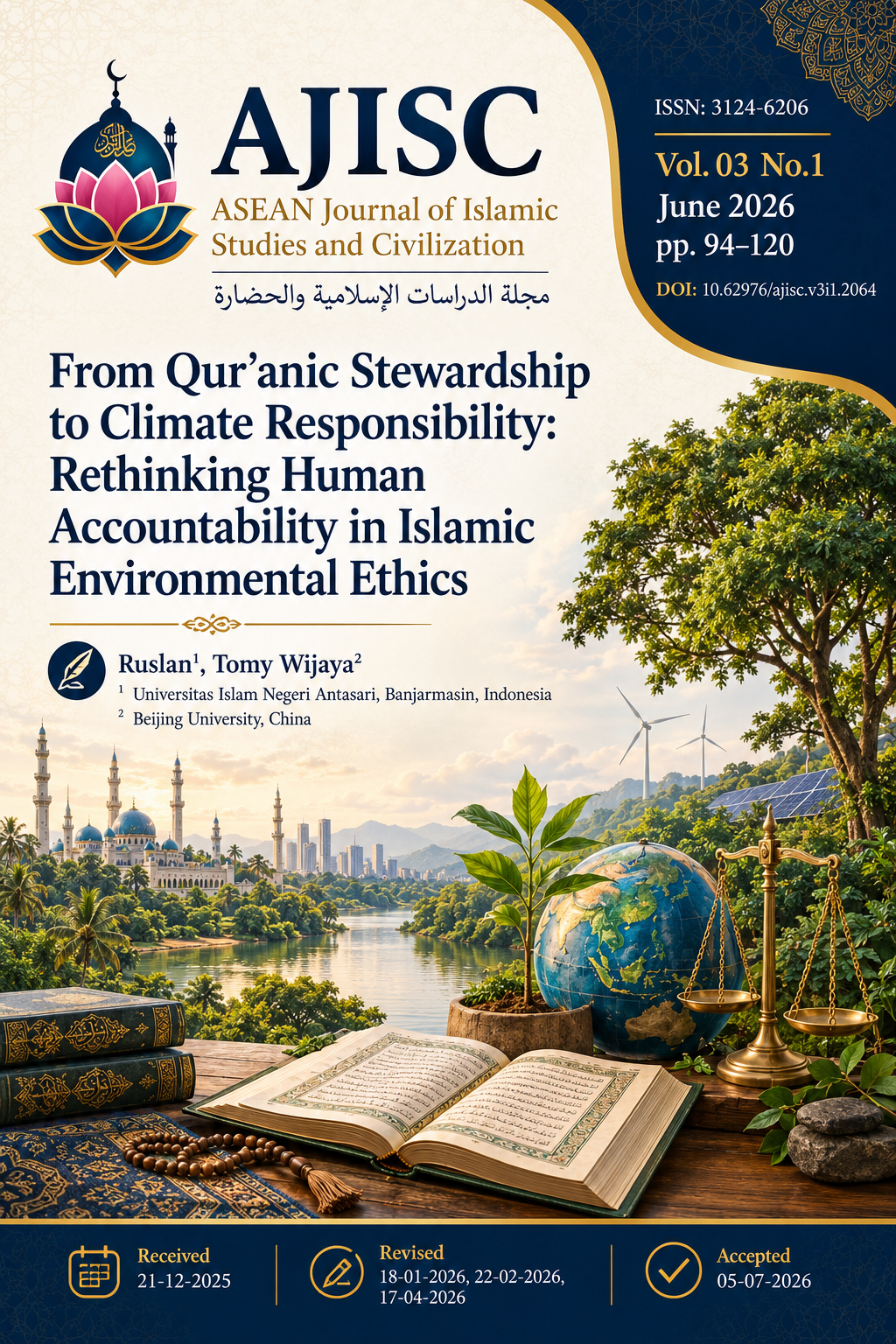
From Qur’anic Stewardship to Climate Responsibility: Rethinking Human Accountability in Islamic Environmental Ethics
Article Sidebar
Main Article Content
Abstract
Human-caused warming has turned environmental degradation into an immediate question of responsibility rather than a distant question of resource management. Yet appeals to religious stewardship are contested because they can inspire conservation while leaving institutional emissions, social inequality, and the duties of powerful actors unspecified. Islamic environmental ethics has developed rich readings of khalīfah, amānah, mīzān, and the prohibition of fasād, but scholarship often moves too quickly from scriptural affirmation to presumed environmental outcomes. Studies of Muslim environmental practices and climate attitudes instead reveal uneven translation, political constraints, and differences between ethical conviction and measurable action. This article asks how Qur’anic stewardship can be reconstructed as an accountable approach to climate responsibility without treating scripture as a technical climate manual. It employs a qualitative, structured documentary analysis of selected Qur’anic passages, an international Islamic climate declaration, Indonesia’s climate fatwa and environmental-law context, and peer-reviewed research published principally between 2022 and 2025. Texts are interpreted through a transparent three-stage matrix linking normative concepts, causal mechanisms, and testable institutional obligations. The analysis identifies three findings: stewardship is best understood as constrained trusteeship rather than ownership; moral exhortation becomes credible when translated into differentiated duties, transparent decisions, and evaluation; and justice must mediate the movement from individual restraint to collective mitigation and adaptation. On this basis, the article proposes a five-part Climate Accountability Translation Framework integrating scriptural warrant, context-specific responsibility, institutional commitments, public evidence, and corrective review. The framework is a conceptual result, not a claim of demonstrated emissions reductions. The article concludes that Islamic environmental ethics can contribute more decisively to climate governance when religious legitimacy is joined to scientific evidence, protection of vulnerable groups, and verifiable public practice. Comparative field research should test whether such arrangements change organizational decisions and climate outcomes.
Article Details

This work is licensed under a Creative Commons Attribution 4.0 International License.




References
Alam, L., Alam, M., Samaalee, A., & Suyatno, S. (2024). Environmental sustainability in Indonesian pesantren: Integrating pious principles and da’wah efforts. Jurnal Ilmu Dakwah, 44(2), 311–328. https://doi.org/10.21580/jid.v44.2.23607
Bagir, Z. A. (2025). Beyond instrumentalization: Lived religion, politics, and justice in Indonesian Muslim environmentalisms. Studia Islamika, 32(3), 439–466. https://doi.org/10.36712/sdi.v32i3.46652
Billet, M. I., Baimel, A., Sahakari, S. S., Schaller, M., & Norenzayan, A. (2023). Ecospirituality: The psychology of moral concern for nature. Journal of Environmental Psychology, 87, 102001. https://doi.org/10.1016/j.jenvp.2023.102001
Blankinship, L. A., Gillaspie, S., Obaideen, K., & Aboul-Enein, B. H. (2024). “… And we have made from water every living thing”: Water conservation and the Holy Qur’an. Environmental Conservation, 51(2), 79–84. https://doi.org/10.1017/S037689292300036X
Bülbül, H. (2024). Understanding the influence of religion on pro-environmental behaviors: An investigation in Muslim families using the theory of planned behavior customized with a religiosity-based subjective norm. Journal of Environmental Planning and Management. Advance online publication. https://doi.org/10.1080/09640568.2024.2403772
Chubachi, N. (2025). Devotion through waste: Ethics of waste sadaqah in Indonesia. Worldviews, 29(2), 148–169. https://doi.org/10.1163/15685357-02902005
Gada, M. Y. (2024). Islam and environmental ethics. Cambridge University Press. https://doi.org/10.1017/9781009308236
Harnowo, T., & Habib, F. H. (2024). Islamic law and environment issues: Indonesian Ulama Council’s fatwas on climate change. AHKAM: Jurnal Ilmu Syariah, 24(1). https://doi.org/10.15408/ajis.v24i1.34161
Hasan, A. M. N., Bagir, Z. A., & Akhda, N. T. (2025). Farming as an act of gratitude: Norms and practices of sustainability among organic Muslim farmers in Blora, Central Java. Jurnal Kawistara, 15(1), 1–18. https://doi.org/10.22146/kawistara.98312
Hasan, N., Mardhatillah, M., Abadi, M. M., & Hidayat, A. R. (2022). Environmental activism in Indonesian pesantren: The role of lora in mainstreaming Islamic eco-theology in Tapal Kuda, East Java. Teosofi: Jurnal Tasawuf dan Pemikiran Islam, 12(2), 280–306. https://doi.org/10.15642/teosofi.2022.12.2.280-306
Hearn, A. X., Huber, F., Koehrsen, J., & Buzzi, A.-L. (2024). The perceived potential of religion in mitigating climate change and how this is being realized in Germany and Switzerland. Journal of Environmental Studies and Sciences, 14, 342–357. https://doi.org/10.1007/s13412-023-00884-z
Indonesian Ulama Council. (2023). Fatwa No. 86 of 2023 concerning the law on controlling global climate change [Fatwa in Indonesian]. https://lplhsda.mui.or.id/fatwa-mui-no-86-2023-hukum-pengendalian-perubahan-iklim-global/
Intergovernmental Panel on Climate Change. (2023). Climate change 2023: Synthesis report. https://doi.org/10.59327/IPCC/AR6-9789291691647
International Islamic Climate Change Symposium. (2015). Islamic declaration on global climate change. United Nations Framework Convention on Climate Change. https://unfccc.int/news/islamic-declaration-on-climate-change
Ives, C. D., & Baker, C. (2024). Engaging faith for a sustainable urban future. Global Sustainability, 7, e45. https://doi.org/10.1017/sus.2024.32
Jameel, S. (2023). Climate change, food systems and the Islamic perspective on alternative proteins. Trends in Food Science & Technology, 138, 480–490. https://doi.org/10.1016/j.tifs.2023.06.028
Karimi, S., Liobikienė, G., & Alitavakoli, F. (2022). The effect of religiosity on pro-environmental behavior based on the theory of planned behavior: A cross-sectional study among Iranian rural female facilitators. Frontiers in Psychology, 13, 745019. https://doi.org/10.3389/fpsyg.2022.745019
Koehrsen, J. (2021). Muslims and climate change: How Islam, Muslim organizations, and religious leaders influence climate change perceptions and mitigation activities. WIREs Climate Change, 12(3), e702. https://doi.org/10.1002/wcc.702
Koehrsen, J., & Ives, C. D. (2025). The multiple roles of religious actors in advancing a sustainable future. Ambio, 54, 1318–1333. https://doi.org/10.1007/s13280-025-02166-0
Koehrsen, J., Buzzi, A.-L., & Hearn, A. (2025). Are religious organizations becoming green? Faith communities’ role in advancing environmental sustainability in Switzerland. Sustainability Science. Advance online publication. https://doi.org/10.1007/s11625-025-01766-9
Maghfiroh, M., Iryani, E., Haerudin, Yani, M. T., Zaini, N., & Mahfud, C. (2024). Promoting green pesantren: Change, challenge and contribution of Nahdlatul Ulama in Indonesia. Nazhruna: Jurnal Pendidikan Islam, 7(2), 409–435. https://doi.org/10.31538/nzh.v7i2.4668
Mazaheri, N. (2024). Faith in science: Religion and climate change attitudes in the Middle East. Global Environmental Politics, 24(1), 52–75. https://doi.org/10.1162/glep_a_00720
McKim, R. (2024). Prospects and possibilities for interfaith environmentalism. Religious Studies, 60(1), 147–159. https://doi.org/10.1017/S0034412523000069
Murad, M. (2023). The Western orientation of environmentalism in the Islamic world today. Religion and Development, 2(1), 41–62. https://doi.org/10.30965/27507955-20230015
Musari, K. (2022). Integrating green sukuk and cash waqf linked sukuk, the blended Islamic finance of fiscal instrument in Indonesia: A proposed model for fighting climate change. International Journal of Islamic Khazanah, 12(2). https://doi.org/10.15575/ijik.v12i2.17750
Mustofa, M. L., Zenrif, M. F., & Barizi, A. (2025). Towards Islamic eco-theology: Indonesian Muslim organizations in climate change mitigation and adaptation efforts. Problemy Ekorozwoju, 20(2), 21–31. https://doi.org/10.35784/preko.7089
Najib, A. A., Rofiq, A., & Fauzi, M. N. (2025). Environmental ethics in pesantren tradition: A living Qur’an study on students’ ecological awareness. Al-Mada: Jurnal Agama, Sosial, dan Budaya, 8(4), 813–831. https://doi.org/10.31538/almada.v8i4.9279
Nasir, Z. M., & Yaacob, M. (2022). Social and religious influences on environmentally ethical behavior of Muslim community in Malaysia. Creative Education, 13, 3996–4016. https://doi.org/10.4236/ce.2022.1312255
OU-SALAH, L., Verschraegen, G., & Van Praag, L. (2024). “Rain has to do with God’s will”: Religion and perceptions of environmental change in a Muslim community in the Souss-Massa region of Morocco. Social Compass, 71(1). https://doi.org/10.1177/00377686241239615
Preston, J. L., & Shin, F. (2022). Opposing effects of spirituality and religious fundamentalism on environmental attitudes. Journal of Environmental Psychology, 80, 101772. https://doi.org/10.1016/j.jenvp.2022.101772
Purnama Aksir, R., Madjid, A., Rahmatullah, A. S., Suud, F. M., & Pasandalan, S. N. (2025). Pro environmental behavior in Islamic boarding schools: A systematic literature review on religiosity, ecological awareness, and social norms. Anfusina: Journal of Psychology, 8(2). https://doi.org/10.24042/ajp.v8i2.30696
Republic of Indonesia. (2009). Law No. 32 of 2009 concerning environmental protection and management, as subsequently amended. https://peraturan.bpk.go.id/Details/38771/uu-no-32-tahun-2009
Sholihin, M., Sugiyanto, C., & Susamto, A. A. (2024). Environmental protection versus economic growth in the views of Muslims: A large sample of empirical evidence. International Journal of Energy Sector Management, 18(6), 1592–1609. https://doi.org/10.1108/IJESM-08-2023-0030
Smith, J. D., Adam, R., & Maarif, S. (2024). How social movements use religious creativity to address environmental crises in Indonesian local communities. Global Environmental Change, 84, 102772. https://doi.org/10.1016/j.gloenvcha.2023.102772
Syarif, A. F., & Irawan, B. (2025). Planting values, reaping harmony: Ecological praxis and religious moderation in an Indonesian eco-pesantren. Refleksi: Jurnal Kajian Agama dan Filsafat, 24(2). https://doi.org/10.15408/refleksi.v24.i2.49798
Yandri, P., Budi, S., & Putri, I. A. P. (2023). Waste sadaqah: A new community-based waste-management practice in Java, Indonesia. Sustainability: Science, Practice and Policy, 19(1). https://doi.org/10.1080/15487733.2023.2212510
Zhang, Q., Husnain, M., Usman, M., Akhtar, M. W., Ali, S., Khan, M. A., Abbas, Q., Ismail, R., Rehman, T., & Akram, M. (2022). Interplay of eco-friendly factors and Islamic religiosity towards recycled package products: A cross-cultural study. Frontiers in Psychology, 13, 840711. https://doi.org/10.3389/fpsyg.2022.840711